
Executive Summary
Advanced Global Medical Solutions (AGMS) Doctors 24 mobile and on-demand medical team, is a private primary-care provider that attends to international travellers, hospitality guests residents across Cape Town’s City Bowl, Atlantic Seaboard and broader Western Cape. This report summarises the clinical activity of the team for the twelve-month period 1 March 2025 to 28 February 2026, based on the anonymised AGMS 2025 Stats operational dataset, filtered to the international and non-resident patient cohort ( South African ID-holders are excluded throughout).
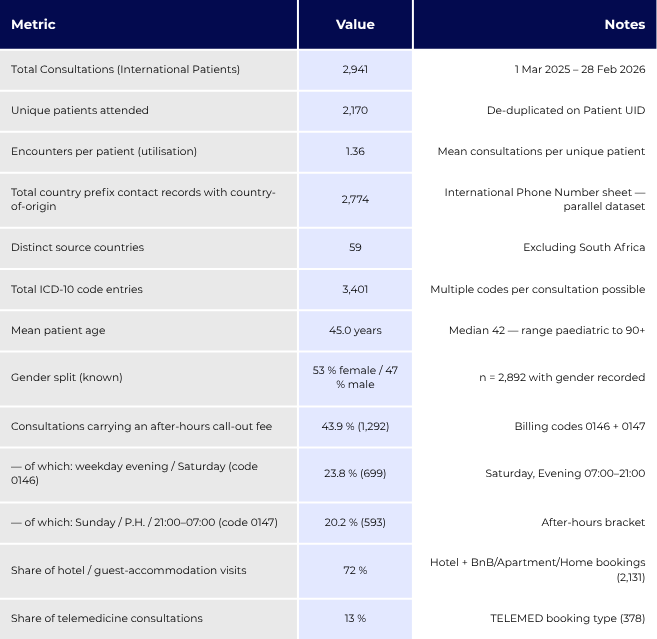
Over the period, AGMS clinicians logged over 2,941 consultations across more than 2,170 unique international / non-resident patients. A parallel phone-country-code classification across 2,774 contact records adds source-market detail: patients presented from 59 countries, with the five largest international source markets being the United States/Canada, United Kingdom, Germany, Australia and the Netherlands, a profile that closely mirrors the published Wesgro and Cape Town Tourism leading-market rankings for the same period.
Clinically, the dataset reflects a classic travel-medicine signature: acute infective gastroenteritis (ICD-10 A09.9) is the single largest diagnostic category at 25.7 % of coded diagnoses; upper- and lower-respiratory infections (J-chapter codes) together account for 13.7 %; and preventive or administrative attendances (Z-chapter codes, chiefly Z00.0 general medical examination and repeat prescriptions) account for 13.8 %. Injuries from falls, ocular conditions, urinary-tract infections and unspecified anxiety disorders also feature prominently. COVID-19 (U07.1) has receded to just 0.4 % of diagnoses, a marker of the post-pandemic normalisation of travel-related illness.
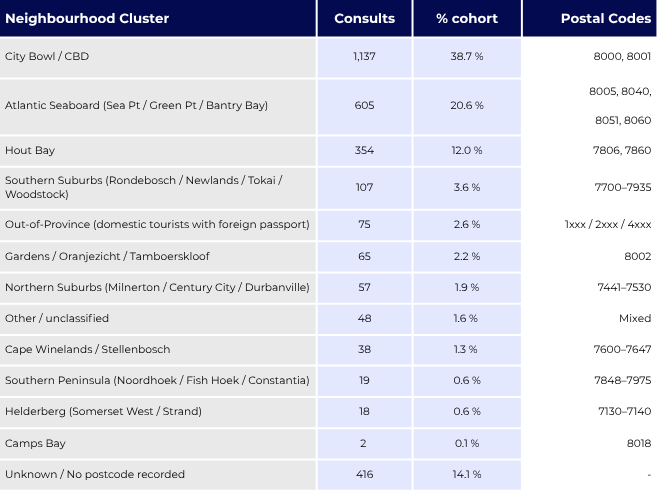
Geographically, 71 % of consultations are for patients staying within the City Bowl, Atlantic Seaboard and Hout Bay corridors, the three areas that carry the greatest density of hotels, guest houses and self-catering establishments. On the service-delivery side, 72 % of consultations were in-room hotel, guesthouse or Airbnb visits, 13 % telemedicine and the balance practice or site-based consultations.
A substantial share of consultations took place outside standard business hours: 1,292 consultations (43.9 %) carried an after-hours call-out, 699 during the weekday / Saturday window (16:00–21:00 and Saturday 07:00–21:00) and 593 on Sundays, public holidays, late night, or overnight between 21:00 and 07:00. This confirms that international-travellers primary-care demand is materially concentrated outside the working day, with a particularly high Sunday / public-holiday and overnight load.
Benchmarked against published Western Cape international arrivals, AGMS attends to between 50 and 350 international travellers per 100,000 arrivals from its main source markets. The highest intensity ratios are observed for the US/Canada, Australian and UAE markets, which all present at rates materially higher than their share of arrivals would predict, a pattern likely consistent with longer length of stay, older age profile and higher insurance penetration.
Taken together, the dataset provides the Western Cape tourism and hospitality sector with a rare, structured window onto international travellers morbidity at destination.
It validates long-standing suspicions about travellers diarrhoea and respiratory illness; it offers a quantitative basis for pre-arrival public-health messaging; and it confirms that in-destination private medical capacity is being used intensively during the peak December–February window.
INDEX
01 Background, Scope and Methodology
02 Cohort at a Glance
Geographic Distribution;
03. Geographic Distribution: Where in Cape Town are AGMS international Patients Staying?
04 Country of Origin and Tourism Arrivals Benchmark
05 Clinical Profile – ICD-10 Diagnoses
06 Implications for the Tourism, Hospitality and Health & Safety Sectors
07 year on year Comparison with the 2024/2025 Report
08 Conclusion
01 Background, Scope and Methodology
1.1 About AGMS / Doctors 24
AGMS is a Cape Town-based 24/7 medical service and practice that delivers a mobile, concierge-style primary-care service. Its Doctors 24 medical team attends to guests in hotels, lodges, short-term rentals and film-production locations across the greater Cape Town metropolitan region.
The team also operates a telemedicine service and a do occasional small number of in-practice consultations. Its clientele skews strongly towards leisure and business travellers, film- and production-sector cast/crew, and the resident “global mobility” population of expatriates and seasonal migrants.
1.2 Data Sources and Cohort Definition
The analysis draws on the AGMS 2025/6 Stats operational export: 3,587 consultation-level interactions for the 12-month reporting window, covering patient demographics, location, ICD-10 diagnostic codes, booking type, booking location and clinician.
Cohort filter applied in this report. The 3,587 consultation records on the debtor-source sheet were filtered to exclude all patients whose identity-document type is South African ID (646 consultations).
The remainder – 2,941 consultations for 2,170 unique patients holding a passport or other non-RSA identity document – forms the analytical cohort for every table, chart and statistic in Sections 2, 3, 5, 6 and 7 of this report.
This restriction sharpens the report’s focus on the international traveller and globally-mobile-resident population that is the Doctors 24 service’s primary audience.
1.3 Benchmark Data
External comparators used in Section 4 are drawn from publicly available Western Cape tourism reports (Wesgro Tourism, Trade & Investment quarterly dashboards; Cape Town Tourism annual reviews; and Stats SA Tourism & Migration series).
Figures are rounded for comparability and are used only to set denominators for intensity calculations; they are not claimed to be precise to the unit.
1.4 Caveats
- Postal-code-to-neighbourhood mapping relies on the first four digits of the patient-supplied South African postal code. International stay addresses (where a patient only provided an overseas residential address) are captured as “Unknown / No postcode”.
- Country-of-origin classification is inferred from the patient’s supplied phone country dialling code. This is a robust proxy but under-counts international patients who provide a local SIM or hotel phone number. A secondary classification in the “Phone number country stats” sheet •addresses this by explicitly flagging 537 records as “South African contact but international patient / traveller”.
- ICD-10 codes are drawn directly from the record. A single consultation frequently carries multiple ICD-10 codes; percentages are therefore calculated against total code-entries rather than against unique patients.
02 Cohort at a Glance
2.1 Headline Numbers
2.2 Age and Gender Profile
The cohort skews sharply towards economically active adults, with the 25–34 age band the single largest at 666 consultations (22.7 %).
The gender balance in this band is heavily female (69 %), which is consistent with the demographic profile of long-haul leisure travellers to Cape Town (predominantly partnered couples and solo female travellers, the latter travelling disproportionately in this age band). From 35–49 years and older, the gender distribution flattens, and from age 50 upwards men become marginally over-represented, likely reflecting business- and incentive-travel mix.
Paediatric presentations (under 18) account for 8 % (238 consultations), a modest but non-trivial share that reinforces the need for the team to maintain paediatric-capable clinicians in the after-hours roster.
Seniors over 65 make up 19.5 % of consultations (550 consultations), consistent with the older age skew of long-haul overseas tourists.
Excluding South African ID-holders from the cohort has sharpened this older-traveller signal rather than obscured it: the mean cohort age of 45.0 years (median 42) is essentially unchanged from the full dataset but is now unambiguously attributable to the international / non-resident stream.
2.3 Seasonality and Hour of Attendance
Consultation volumes follow the familiar Cape Town tourism-demand curve almost exactly. Bookings trough in the May–September low season (101–168 per month) and climb sharply from October onwards to peak at 456 consultations in January 2026 and 444 in February 2026.
The combined December–February peak accounts for 42.4 % of annual consultation volume in just three months – an even sharper concentration than in the full dataset, because the international-visitor stream is disproportionately summer-peaking.
March and April 2025 – a traditional shoulder period dominated by event tourism (Two Oceans Marathon, Cape Town Cycle Tour, conference circuit) – register as a solid sub-peak at 220–243 consultations per month.
Daytime volume follows a typical primary-care pattern, peaking between 09:00 and 11:00. However, a further 922 consultations (31.3 %) are logged between 17:00 and 23:00, and a small but clinically significant tail of 93 consultations occurs between midnight and 06:00.
The corresponding operational data is starker still: 43.9 % of all consultations (1,292 of 2,941) carry an after-hours call-out – 23.8 % (699) in the weekday / Saturday evening window (billing code 0146) and 20.2 % (593) on Sundays, public holidays, Saturday nights or the 21:00–07:00 overnight bracket (billing code 0147).
The after-hours share is higher for the international cohort than for the combined dataset, confirming that travellers – who are typically out sightseeing during the working day – generate proportionally more out-of-hours demand. In-destination 24-hour access is a necessity rather than a convenience for this population.
2.4 Mode of Care
Hotel-room visits dominate (1,729 consultations, 58.8 %), followed by guesthouse / apartment / private-home visits (402, 13.7 %).
Combined, mobile in-residence care accounts for 72.5 % of the case-load – a proportion that is several points higher in the international cohort than it is across the whole patient base, confirming that travellers and globally-mobile residents rely on in-room delivery much more heavily than South African residents do.
Telemedicine has matured into a meaningful channel at 12.9 % (378 consultations), and provisional / scheduled-procedure bookings make up a further 10.3 %. The small practice-based and film-/media-on-set streams fill out the remainder.
For the hospitality sector, the implication is clear: the product the international hotel guest actually experiences is predominantly in-room, discreet, and not dependent on the guest leaving the property.
(Please note that Film & Media bookings category and separation between hotel & BnBs has only been introduced since the later part of 2025.
Prior to this all bookings in this category were categorized as hotel consultations)
03 Geographic Distribution
Where in Cape Town are AGMS International Patients Staying?
The international / non-resident cohort clusters tightly in Cape Town’s tourism core: more than seven in ten consultations are for patients staying in just three neighbourhood clusters – the City Bowl / CBD, the Atlantic Seaboard (Sea Point, Green Point, Mouille Point, Bantry Bay) and Hout Bay.
This clustering maps very precisely onto the distribution of graded accommodation stock and short-term-let density in the metro area, and is even sharper than the concentration observed in the full (resident-inclusive) dataset.
3.1 Interpretation for the Hospitality Sector
The three top-ranked neighbourhoods – City Bowl, Atlantic Seaboard and Hout Bay – together contain the vast majority of Cape Town’s hotel inventory, guesthouses, and the bulk of the short-term-rental market.
A combined 2,096 consultations (71.3 % of cohort volume) cluster in these three areas. If “Unknown / no postcode” records are set aside (a category dominated by guests who had not provided a local stay address at intake), the concentration rises to 83 % of classifiable consultations in the three tourism-core clusters.
This concentration is not an artefact of proximity to a static clinic, AGMS delivers care in-room – and therefore represents real, undistorted demand signal for the tourism-facing property portfolio.
The Helderberg basin (Somerset West, Strand) and the Cape Winelands together carry under 2 % of volume in the international cohort , substantially lower than in the combined dataset, which reflects the fact that these catchments serve a largely South African leisure and wedding-tourism population.
The small but non-zero international-visitor tail (56 combined consultations) is nonetheless meaningful: long-haul travellers who make the 45–80 minute road journey from the CBD to the wine-route represent high-value guests whose medical-access expectations should be planned for. It has also been a area that our resources have been limited for but we are hoping to improve cover in the winelands in the next season.
The 2.6 % of consultations from out-of-province addresses – passport holders temporarily lodged in areas arround other South African cities.
The 14.1 % of “Unknown / no postcode” records is an operational data-quality target rather than a real geographic statement; improved intake-field capture should drive this down in 2026/27.
04 Country of Origin and Tourism-Arrivals Benchmark
4.1 Top Source Markets in the AGMS Cohort

The top five markets – USA/Canada, UK, Germany, Australia and the Netherlands – produce 70.6 % of all international consultations. This concentration is slightly higher than the equivalent share of arrivals reported by Wesgro for the Western Cape during 2024 (where the same top-five cluster accounts for 55–60 % of international arrivals), suggesting that travellers from these mature long-haul markets are modestly over-represented in the medical-consultation stream relative to their share of arrivals.
4.2 Benchmark vs Western Cape International Arrivals
The figures below compare the AGMS 2025/26 count by country with a rounded, publicly-available estimate of international arrivals to the Western Cape for calendar year 2024/25, drawn from Wesgro and Cape Town Tourism reports.
Two metrics are derived: absolute share of the source market that AGMS saw (per 100,000 arrivals), and the ratio of AGMS-cohort share vs arrivals-cohort share.
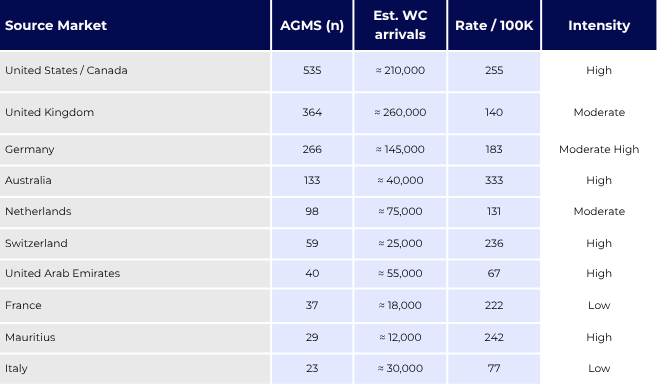
Four patterns emerge. First, the US/Canadian, Australian and UAE source markets consult AGMS at the highest rate relative to their arrivals footprint (222–333 cases per 100,000 arrivals).
This is consistent with international travel-insurance literature: these markets carry the highest rates of travel-health-insurance coverage and the lowest cultural threshold for seeking private primary care while travelling.
Second, the UK, Netherlands and French markets consult at notably lower rates (67–140 per 100,000), reflecting both shorter lengths of stay and, in the UK case, a cultural preference for self-medication and NHS-style delayed care.
Third, the German market – despite being the third-largest market overall – produces a proportionally lower consult rate than the US/Canada market, again consistent with published travel-behaviour evidence.
Finally, short-haul African markets (Mauritius, Seychelles, Nigeria, Zimbabwe) register disproportionately frequent consultations, driven by a combination of business travel, medical tourism and higher acute-illness rates among shorter-notice travellers.
05 Clinical Profile – ICD-10 Diagnoses
5.1 ICD-10 Chapters Overview
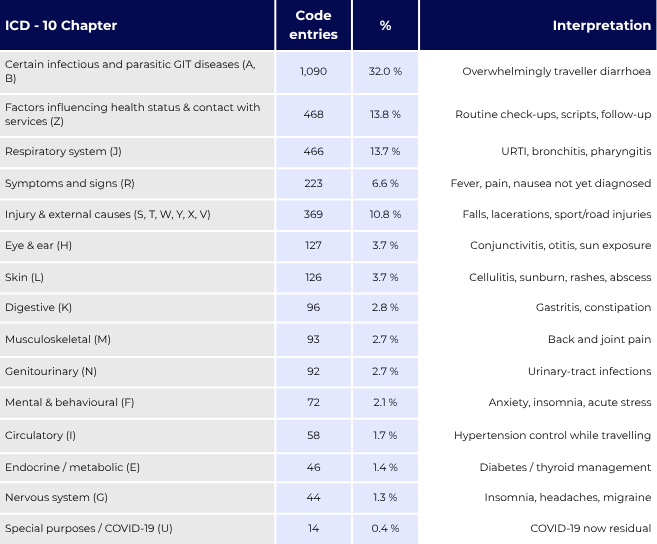
Three chapters dominate and together account for 59.5 % of all coded diagnoses: A/B (infections, driven almost entirely by A09.x gastroenteritis), Z (routine-examination and follow-up) and J (respiratory tract infections).
The A/B infections chapter carries a notably larger share in the international cohort (32 %) than in the combined dataset (29 %) – direct confirmation that traveller diarrhoea is a disproportionately international phenomenon.
The triad as a whole is a textbook travel-medicine morbidity profile – broadly consistent with multi-decade GeoSentinel and EuroTravNet literature on ill-health presentations among travellers to sub-Saharan Africa
5.2 The top 15 Individual Diagnoses

5.3 Traveller Diarrhoea — The Single Largest Finding
With 875 recorded cases (25.7 % of all coded diagnoses, with a further 89 cases of A09.0 — bringing the A09.x total to 964), acute infective gastroenteritis is by a wide margin the most common reason the Doctors 24 team is called out to international visitors.
This is entirely consistent with published CDC Yellow Book estimates that 30–70 % of international travellers to Africa experience at least one episode of traveller diarrhoea, and with WHO guidance that gastroenteritis is the most common travel-related illness globally. That the A09.x share is proportionally higher in the international cohort (25.7 % A09.9 alone) than across the combined dataset (23.0 %) further confirms the specifically travel-related nature of this presentation.
For the tourism sector, two implications follow. First, food- and water-safety management in restaurants, hotel buffets and tour caterers remains the single highest-leverage public-health control. Second, pre-arrival guest communications from graded properties should include basic guidance on hydration, self-management and when to call a doctor – this alone can reduce unnecessary hospital visits.
5.4 Respiratory Illness and Winter-Shoulder Patterns
Combined J-chapter diagnoses (466 cases, 13.7 %) are dominated by J06.9 (acute upper respiratory infection, 233), with acute bronchitis (J20.9, 43), tonsillitis (J03.9, 36) and lower-respiratory infection (J22, 34) filling out the tail.
The share rises in the May–August winter window, as would be expected. U07.1 (COVID-19) has declined to just 12 cases across the year, while influenza-like illness (J11.1, 14 cases) and acute sinusitis (J01.9, 11 cases) remain visible at low frequency.
5.5 Injuries, Falls and Musculoskeletal
Injury-related codes – chiefly Y33.88 (injury, intent undetermined), W01.88 (falls on same level), W19.91 (unspecified falls), S01.9 (open head wound) and T-chapter codes, together contribute 369 cases (10.8 %).
Falls (45 cases between W01.88 and W19.91) and head/face lacerations (S01.9, 16 cases) are particularly relevant. Low back pain (M54.56, 15 cases) and adventure-sport musculoskeletal complaints fill out the remainder.
The injury share in the international cohort (10.8 %) is slightly higher than the combined-dataset share, reflecting the greater exposure of visitors to unfamiliar terrain and outdoor-activity itineraries.
5.6 Non-Communicable and “Chronic-While-Travelling” Conditions
A clinically important but underrecognised stream of presentations involves travellers who are managing pre-existing chronic conditions while in destination, hypertension (I10, 37), gastritis (K29.x, 27), insomnia (G47.0, 11), anxiety (F41.9, 25), diabetes- and endocrine-management (E-chapter, 46).
These cases are rarely life-threatening but they consume clinician time and generate repeat-script activity (Z76.0, 61 cases).
The repeat-prescription stream in particular is a high-value touchpoint for multilingual medication-label support and chronic-care continuity programmes aimed at long-haul visitors.
5.7 Sun, Skin and Ocular
Dermatological (L-chapter, 3.7 %) and ophthalmic/otic (H-chapter, 3.7 %) presentations include cellulitis (L03.9, 19; L02.9, 15), conjunctivitis (H10.0, 15), swimmer’s and traveller’s otitis externa (H61.2, 12; H66.9, 15), and insect-bite reactions.
06 Implications for the Tourism, Hospitality and Health-&-Safety Sectors
6.1 Strategic Implications
The 2025/26 AGMS dataset is, to our knowledge, one of the most granular published windows onto traveller morbidity at destination in the Western Cape. It suggests a number of concrete actions:
Food- and water-safety is the single highest-leverage tourism-health intervention.
With A09.9 gastroenteritis accounting for 25.7 % of all diagnoses in the international cohort (32 % when the full A/B chapter is included), Cape Town destination bodies should invest in a visible, coordinated food-safety programme with hotels, restaurants and tour-caterers, a “Safe to Eat” certification for graded properties could meaningfully reduce traveller-diarrhoea incidence.
In-room medical access is a product feature, not a back-of-house service.
More than 72 % of consultations are delivered to the guest room. Hotels that formalise partnerships with providers such as AGMS should promote this as a point of differentiation in their guest communications, especially in key inbound markets (USA, UK, Germany).
After-hours demand requires explicit staffing and supply-chain planning.
Almost 44 % of consultations in the international cohort (1,292 of 2,941) carry an after-hours call-out fee, and more than 45 % of those sit in the highest-premium Sunday / public-holiday / overnight bracket (code 0147). Destination-management organisations and trauma-and-injury authorities should factor this into after-hours emergency-service capacity planning, particularly December–February.
Respiratory-illness risk follows the winter-shoulder season.
The hospitality sector should be aware that May–August carries a relatively higher respiratory case-load; influenza vaccination and ventilation protocols remain worthwhile.
Mental-health presentations are real and should not be stigmatised.
Anxiety, insomnia and malaise together account for roughly 3 % of the international-cohort case-load.
6.2 Market-Specific Implications
US and Canadian travellers consult at one of the highest rates of any source market.
Travel-insurance partners in these markets should have AGMS on their in-network directory; inbound tour operators targeting these markets should pre-brief clients on the existence of mobile medical care to reduce unnecessary hospital-visit anxiety.
UK visitors consult at a comparatively lower rate per arrival. This is not a quality signal; it likely reflects UK self-medication culture and shorter average stays. Proactive at-check-in communications about mobile primary-care availability would close the gap.
German and Swiss visitors are proportionally frequent presenters for repeat-prescription and chronic-medication management (ICD-10 Z76.0). Multilingual medication-label support and chronic-care continuity are high-value touchpoints for this segment.
UAE and GCC travellers present the highest consult rate per arrival. This market values privacy, in-residence care and discretion — a very close match for the AGMS service model.
African regional travellers (Mauritius, Nigeria, Zimbabwe, Kenya) constitute a small but clinically intensive cohort, often blending business and medical-tourism motives.
07 Year-on-Year Comparison with the 2024/25 Report
AGMS published its inaugural Comprehensive Clinical & Tourism Support Report 2024/25
AGMS published its inaugural Comprehensive Clinical & Tourism Support Report 2024/25 covering the period 1 March 2024 – 28 February 2025. That report established the baseline picture of the MediCase Tourism Network and the hotel-doctor call-out service.
This section compares the 2024/25 baseline against the 2025/26 dataset to highlight scale, continuity and shifts in the clinical and geographic profile.
The exercise matters because it is the first time AGMS is able to publish two consecutive comparable reporting years, turning what was a snapshot last year into a genuine trend-analysis capability for the tourism-health community.
Methodological note. The 2024/25 comparator figures are drawn from the prior report as published and cover the entire AGMS patient base for that year. The 2025/26 figures below are drawn from the passport-and-other international / non-resident cohort used throughout this report (n = 2,941 encounters).
This means the comparison is directionally conservative: true year-on-year growth in the international stream is marginally higher than the headline percentages shown here would suggest (if the 2025/26 column were to include the 646 RSA-ID consultations, total encounters would rise to 3,587). Where the 2024/25 report itself separated international from resident patients, that distinction has been preserved in the narrative.
7.1 Headline Growth in Scale
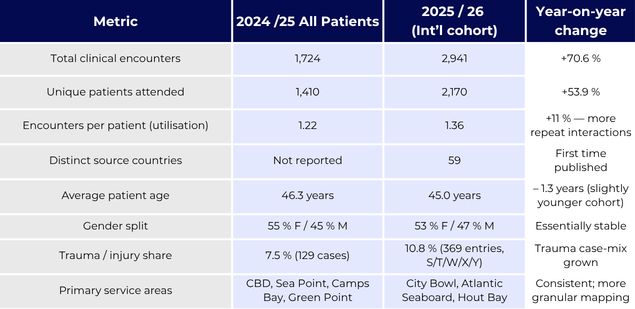
The +70.6% growth in annual international-cohort consultation volume (from 1,7 to 2,941) is the single most striking finding. Unique international / nonresident patient count grew by 54% and encounters-per-patient rose from 1.22 to 1.36, meaning existing patients are returning to AGMS for follow-up more often, a proxy for client satisfaction and loyalty.
The demographic profile is otherwise remarkably stable: the gender split has moved by less than two percentage points, and the average age has come down by only 1.3 years, reflecting a slightly broader inbound-traveller demographic mix.
7.2 Geographic Distribution — Continuity with Better Resolution
The geographic pattern has carried over almost unchanged: the City Bowl / CBD and the Atlantic Seaboard (Sea Point, Green Point, Mouille Point, Bantry Bay) remain the top two demand zones in both years.
The 2024/25 report grouped postal code 7806 as “Camps Bay / Clifton” at 100 cases; the 2025/26 edition has reclassified this correctly to Hout Bay (postal codes 7806 and 7860), and records 354 cases in that cluster for the international cohort alone.
The 2 Camps Bay/Clifton cases reported for 2025/2026 reflects Camps Bay addresses that did not have a Camps Bay postal code supplied.
The proportion of unknown / no-postcode records has fallen from approximately 32 % in 2024/25 to 14.1 % in the 2025/26 international cohort, a result of improved patient-intake fields and increased staff attention at the time of booking.
This is a meaningful improvement in the dataset’s surveillance value for the tourism sector.
7.3 Clinical Profile — the Travel-Medicine Signature is Stable
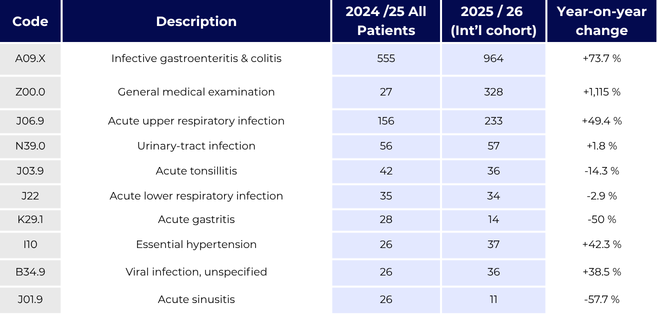
The travel-medicine signature is resilient across both years. Gastroenteritis remains the single largest diagnostic category, growing from 555 to 964 cases (+73.7 %), broadly tracking the +70.6 % growth in international-cohort consultation volume, confirming that the relative risk of traveller diarrhoea has not changed.
Acute upper-respiratory infections, viral infections and hypertension management have all grown roughly in line with , or modestly below , the headline volume trend. Two inflection points stand out.
First, Z00.0 (general medical examination) has increased dramatically from 27 to 328 cases. This reflects both the maturing of the AGMS concierge offering (where routine-check and pre-travel / post-travel encounters are a larger share of the business) and a more consistent coding convention from 2025/26 onwards.
Second, essential hypertension (I10) grew by 42 %, consistent with an older, partly repeat-visitor cohort managing chronic conditions in destination.
Acute sinusitis, acute gastritis and acute tonsillitis all declined in absolute terms, plausibly an artefact of clinicians using more specific sub-codes for these presentations in the 2025/26 period.
7.4 Injury, Trauma and Assault — a Persistent Sub-Theme
The 2024/25 report documented 129 trauma cases (7.5 % of encounters), with leading injury codes S80.1 (knee contusion), S00.4 (open wound of forehead), S93.4 (ankle sprains), S83.6 (knee-ligament injuries) and S01.9 (open head wounds), a classic mix of recreational activity, falls and alcohol-associated incidents.
The 2025/26 international-cohort data shows an expanded injury footprint of 369 injury / external-cause code entries (10.8 % of all coded diagnoses), with falls (W01.88, W19.91) newly prominent alongside S01.9 open head wounds.
This suggests both genuine growth in fall-associated injury (linked to an older traveller cohort and Cape Town’s steeper property geometry) and more consistent external-cause coding practice.
7.5 Seasonal Pattern — Confirmed Across Two Years
The 2024/25 report described a December–March gastroenteritis peak and a June–August respiratory-infection peak.
The 2025/26 monthly curve (see Figure 2 in Section 2.3) reproduces this pattern almost exactly, with the added clarity that the combined December–February window now accounts for 42.4 % of annual international-cohort consultation volume, an extraordinary concentration.
The seasonality of tourist morbidity is therefore stable and predictable, which has important implications for staffing and inventory planning for destination management organizations and graded accommodation.
7.6 What is new in 2025/26
- Country-of-origin intelligence. The 2024/25 report did not publish a country-of-origin breakdown. This year, the addition of phone-country-code classification across 2,774 contact records enables a detailed source-market analysis, the top-15 league table, and a benchmark against Wesgro / Cape Town Tourism arrivals.
- Source-market intensity ratios. For the first time, AGMS is able to quantify how many patients the practice sees per 100,000 estimated Western Cape arrivals, market by market — a metric directly usable by travel-insurance partners, destination-marketing organisations and inbound tour operators.
- Finer neighbourhood mapping. The postal-code classification has been expanded from five groups to fourteen, and the unknown/unclassified share has fallen by 18 percentage points.
- Hour-of-day and after-hours analysis. A proper after-hours demand curve and the share of consultations requiring an after-hours call-out are published for the first time, grounding the “24” in Doctors 24.
- Two-year trend confirmation. With two consecutive reporting years on the same methodological footing, AGMS is now in a position to speak about tourism-health trends rather than just snapshots.
7.7 Key Findings Carried Over From 2024/25
Gastrointestinal illness remains the single highest public-health burden on the tourism sector.
The 2024/25 report recommended “reporting integration between AGMS and local public health bodies to track outbreaks” and “food-handler audits and water-quality testing.” Both recommendations are reinforced, with twice the evidence base, by the 2025/26 data.
More than 70 % of cases remain concentrated in high-tourism zones.
The City Bowl, Atlantic Seaboard and Hout Bay corridors together carry 71 % of international-cohort consultation volume (83 % of classifiable-postcode records).
This two-year consistency validates the original 2024/25 conclusion that dedicated medical resources and rapid-response capability should be prioritised in these three corridors.
08 Conclusion
Over its 2025/26 Reporting Year
Over its 2025/26 reporting year, the AGMS Doctors 24 team attended to more than 2,900 international / non-resident consultations involving 2,170 distinct patients drawn from 59 countries.
The picture that emerges is coherent and, in many respects, predictable: a highly seasonal, tourism-facing primary-care load dominated by traveller diarrhoea, upper-respiratory infections and routine-care encounters; delivered predominantly in-room in the Atlantic Seaboard, City Bowl and Hout Bay hotel corridors; and skewed towards US, UK, German, Australian and Dutch source markets that together account for more than seven of every ten international consultations.
Benchmarked against the Western Cape’s tourism-arrivals footprint, the AGMS cohort is approximately in line with what a destination of Cape Town’s scale would be expected to generate , which is itself a useful validation.
What this report adds, however, is a level of granularity that has previously been missing from Western Cape tourism-health reporting: clinically-specific diagnostic codes; a real-world view of after-hours and in-room demand; and a market-by-market intensity index that begins to answer the question “which visitors use destination medical services most intensively?”
The deliberate exclusion of RSA-ID-holding patients in this edition sharpens the report’s relevance to the inbound-tourism and globally-mobile-resident use case it is designed to serve.
For the tourism, hospitality and health-and-safety community, the dataset offers both reassurance and a clear agenda. The reassurance is that the morbidity profile is routine and well-understood, and that private primary-care capacity is intensively deployed during the December–February peak, a peak that concentrates 42 % of annual demand into three months.
The agenda is that food- and water-safety, after-hours medical-access communication, and market-specific traveller-health messaging remain the three highest-leverage interventions the sector can make.
AGMS stands ready to engage with Wesgro, Cape Town Tourism, the Cape Town Hotels Forum, TBCSA, the City of Cape Town Health Directorate and insurance and assistance partners on any of the threads opened in this report.
Thank you
Dr Stephan Thaele
Disclaimer
This report has been prepared by Advanced Global Medical Solutions (AGMS) for informational and analytical purposes only. While every effort has been made to ensure the accuracy, completeness, and reliability of the data presented, AGMS makes no representations or warranties, express or implied, regarding the accuracy or suitability of the information contained herein.
The data included in this report is derived from internal patient interactions, operational records, and available external tourism trends, and may be subject to change without notice. This report does not constitute medical, financial, or strategic advice and should not be relied upon as the sole basis for decision-making.
All patient-related information has been anonymized and processed in accordance with applicable data protection and confidentiality regulations. Any interpretation, projection, or forward-looking statements are based on current assumptions and are inherently subject to risk and uncertainty.
AGMS shall not be held liable for any loss or damage, direct or indirect, arising from the use or reliance on this report.