
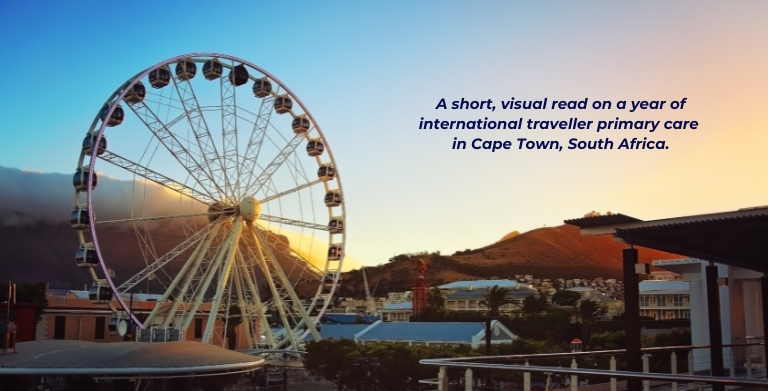
A short, visual read on a year of international traveller primary care in Cape Town, South Africa.
What’s inside.
This snapshot distills the full Doctors 24 clinical report into four visual chapters, where our international patients were from, what main illnesses we treated, when and how we were called out, and what those patterns mean for the Cape Town hospitality sector.
The stats on the following pages reflects our house-call, telemed consult or after-hours visit delivered to travellers between 1 March 2025 and 28 February 2026.
Who is this report for?
The report is designed to be read by GMs, concierges and duty-managers and can help understand and give insight to the illnesses most likely to affect their guests.
INDEX
01 Who we cared for
02 What we treated
03 When and ow we were called
04 What this means
Two in three international visitors we saw were travelling from just five countries, the United States or Canada, the United Kingdom, Germany, Australia, or the Netherlands.
01 Who We Cared For
Young to old, couples to solo travellers, a cross-section of the international visitors Cape Town welcomes each year.
Where They Came From
Top 5 markets alone = 70.6% of international consultations, drawn from 2,774 phone prefixes with an identifiable country code.
The remaining 29% spans 54 other nations, from Brazil and Argentina to India, China and the UAE, showing just how geographically diverse Cape Town’s visitor base that seek medical has become.
The 25–34 age band was the single largest, and almost 70% of those young-adult visitors were women.
Where They Stayed
The V&A Waterfront and CBD hotel corridor absorbed 38.7% of all call-outs, the Atlantic Seaboard (Sea Point–Camps Bay–Clifton) another 20.6%, and Hout Bay a further 12.0%. Together these three precincts accounted for seven in every ten visits.
02 What We Treated
The travel-medicine signature is textbook: tummies, coughs, and a surprising amount of routine care while away from home.
The six most common diagnoses
From 3,401 individual ICD-10 codes recorded this year, just six diagnoses drove more than half of all clinical activity. The chart below shows the volume of each, with gastroenteritis far in the lead.
1 in 4 consultations was a case of traveller diarrhoea.
Acute infection gastroenteritis (ICD-10 A09.9) alone accounted for 25.7% of all diagnoses, far and away the most common reason Doctors 24 was called. Add the related A09.0 code and the total rises to 964 cases.
Food-and-water safety at hotels, restaurants and tour caterers is, by a wide margin, the single highest-leverage public-health intervention the tourism sector can make.
Other Things We Saw
Injuries & falls:
369 injury or external-cause entries (10.8%), think wet pool decks, cobblestones and steep Cape Town stairs. Falls are a growing share.
Urinary-tract infections:
57 cases, a small but clinically important stream, disproportionately affecting women travellers.
Chronic-while-travelling:
Hypertension (37), anxiety (25), insomnia (11), diabetes-related management and a busy repeat-prescription stream (Z76.0 = 61 scripts).
COVID-19:
Just 12 cases across the year, now a residual diagnosis rather than a clinical driver.
03 When & How We Were Called
Traveller demand is strongly seasonal, strongly evening-and-weekend, and overwhelmingly delivered in the guest’s room.
A year with a clear peak season
Demand climbs gently from early-winter lows of around 100–140 consultations a month, plateaus through spring, then nearly triples into the December–February peak , 1,247 consultations in just three months.
How Care Was Delivered
The mix of care settings captures the Doctors 24 promise in a single bar: a house-call to the room is the default, a telemedicine for a provisional script is the back-up, and only a small share of cases need anything more structured than that.
04 What This Means
Its been a bigger year for tourism and patients (travellers), a sharper picture, and three priorities for the tourism sector, plus a look at how we’ve grown since last year’s report.
- Food and water safety.
A coordinated “Safe to Eat” programme across graded hotels, restaurants and tour caterers is the single biggest lever for cutting traveller diarrhoea.
- Treat in-room medical access as a product feature.
More than 7 in 10 consultations happen in the guest’s room. Properties that formalise partnerships can promote this as a differentiator for US, UK and German markets.
- Plan for the after-hours, peak-summer surge.
Almost half of international-visitor demand lands outside daytime hours, and 42% of it in a single three-month window. Staffing, inventory and communications should reflect that reality.
“Two years of consistent data make one thing clear: International travellers choose Cape Town in ever-growing numbers and when they need medical care, they want it delivered quickly, discreetly and in the comfort of their hotel room. Our job is to make that experience as routine as a good breakfast.”
Dr. Stephan Thaele, CEO, Advanced Global Medical Solutions